RAG Development
Ment Tech builds retrieval-augmented generation (RAG) systems that answer questions from your policies, contracts and knowledge bases with source citations. We enforce document-level permissions and measure answer accuracy before launch.
Which suppliers can we terminate without penalty this year?
Retrieved from 3 sources
Supplier MSA, Northwind.pdf
§ 14.2
Contract register, SharePoint
Row 38
Procurement policy v6
p. 9
Two suppliers allow termination for convenience with 60 days' notice [1][2]. Policy requires CFO sign-off before notice is sent [3].
Grounded, 3 citations
Only documents this user is allowed to open
Trusted by Teams Across Global Markets
Why RAG
A language model alone guesses from its training data. RAG retrieves the right passages from your own sources first, so answers are current, specific to your business and traceable.
Responses link to the exact document, page or section they came from, so people can verify before they act.
Access rights from SharePoint, Confluence, Drive and your databases are enforced at query time for every user.
Evaluation sets built from real questions track retrieval quality and groundedness before launch and after every change.
What We Build
From architecture and data pipelines to retrieval engineering, integration and evaluation, we cover the full RAG build and connect it to the CRMs, ERPs, APIs and cloud platforms your teams use.
The right data sources, retrieval setup, models and hosting, aligned with your wider AI plans.
Knowledge assistants and search tools built around your use case, data and workflows.
Chatbots for customer service, internal knowledge and document Q&A where answer quality matters.
Ingest, clean, chunk and sync documents, APIs, databases and business systems, with permissions carried along.
Semantic and keyword search, metadata filters and rerankers that find the most relevant context.
Retrieve from PDFs, scanned documents, tables, charts and images, not just plain text.
Multi-step retrieval and knowledge graphs for questions that span several sources or connected facts.
Measure retrieval, accuracy and latency, then fix weak spots before they reach users.
Architecture
Data, retrieval and generation brought together in one reliable setup, with evaluation and security wrapped around every layer.
Reference Architecture
01
Sources
SharePoint
Confluence
PostgreSQL
02
Ingest and Index
LlamaIndex
Elasticsearch
03
Vector Search
Pinecone
Weaviate
Qdrant
04
Answer with Citations
OpenAI
Claude
Permissions are checked at retrieval time, so answers never include restricted content
Each answer is retrieved only from documents the user is allowed to open, then cited back to the source.
01
Documents, wikis, tickets and databases are ingested, cleaned, chunked and embedded, and kept in sync as sources change.
02
Hybrid search, metadata filters and reranking select the passages that best answer each question, filtered by user permissions.
03
The LLM writes an answer only from retrieved context, cites its sources and says when the information is not there.
04
Retrieval recall, groundedness, citation quality and latency are measured on real questions before and after launch.
05
Access controls, encryption and query logs at every layer, with governance controls for higher-risk use cases.
Proof
Conversational systems, connected data and intelligent workflows: the same capabilities that power our RAG builds, in production and in live demos.
A conversational AI assistant that understands queries, keeps context and works across Google Calendar, Slack, Notion and Trello.
45%increase in user productivity
A data platform that brings information from multiple sources together and makes it easier to access and use across workflows.
84%improvement in feed accuracy
Live Knowledge AI Demos
Answers from a support knowledge base, with escalation to people.
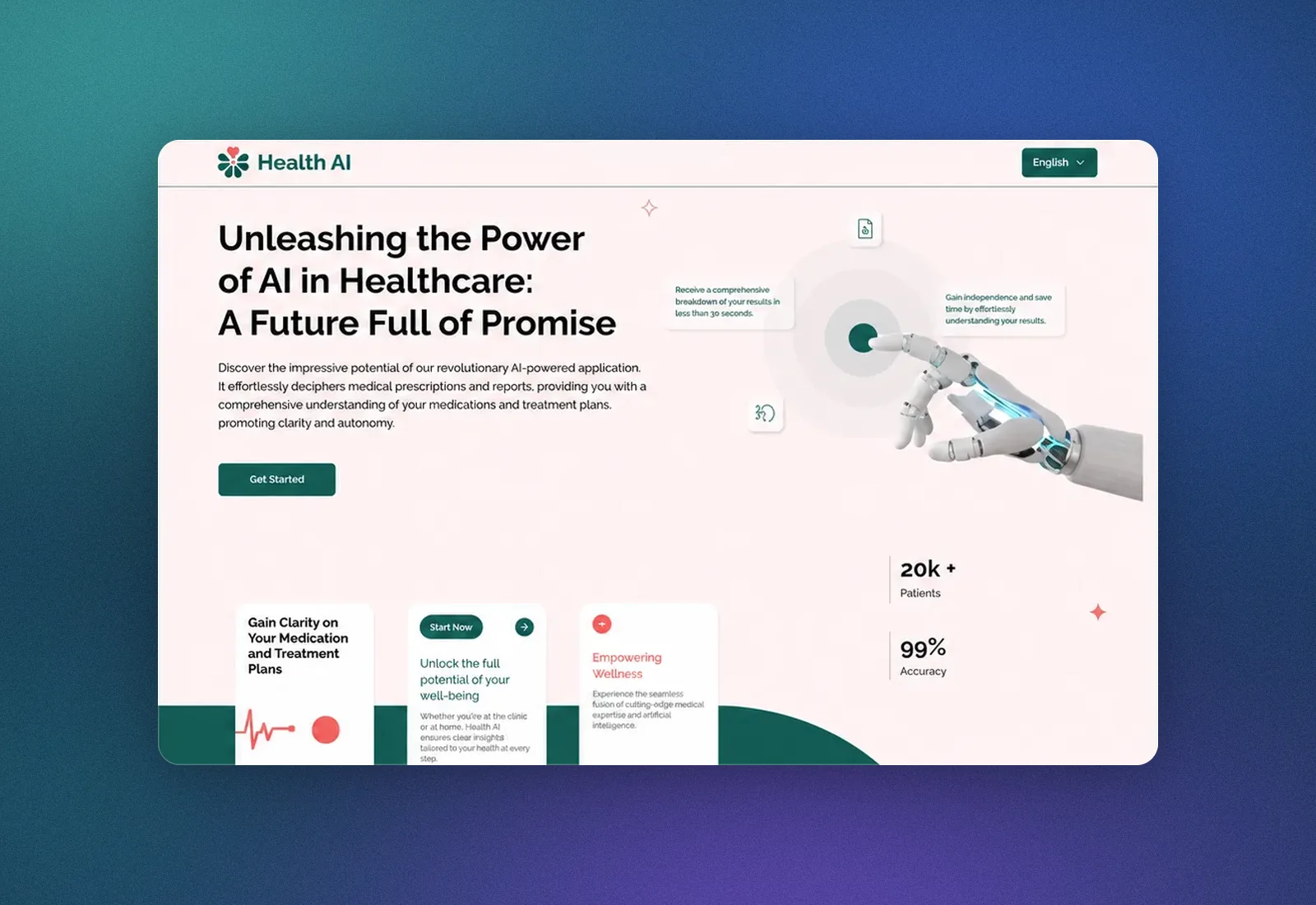
Organizes and explains medical records for patients and families.
Research and portfolio insight grounded in market and client data.
150+
Engineers
65+
Platforms Successfully Built
30+
Industries and Markets Served
2018
In Business Since
100+
Clients Served Globally
How We Deliver
Retrieval quality, accurate answers, secure access and production performance at every step. Already have a RAG pilot? Our 90-day production sprint gets it working on real data by week 3.
01
What the system must answer, who will use it and which sources it should rely on.
02
Clean, structure, chunk and organize business data so context is retrieved reliably.
03
Vector, hybrid and metadata search with reranking, tuned to your data and questions.
04
Connect retrieval to the right model, with context limits, citations, permissions and live data APIs.
05
Test relevance, accuracy, groundedness, latency and citation quality on real business queries.
06
Go live with monitoring, then keep improving retrieval and answers from real usage.
Technology
A flexible stack for ingestion, retrieval, orchestration, deployment and monitoring, chosen to fit your existing environment and hosting rules.
Pinecone
Weaviate
Qdrant
Milvus
pgvector
Elasticsearch
OpenAI embeddings
Cohere Rerank
Voyage AI
BGE
LangChain
LlamaIndex
LangGraph
Haystack
OpenAI GPT
Anthropic Claude
Google Gemini
Meta Llama
Mistral
Why Ment Tech
Retrieval comes first, every system is built around your data and permissions, and the architecture is designed for latency, scale and monitoring from the start.
Chunking, search quality, filtering and reranking tuned so the model gets the right context.
Test answers on your own documents early, then improve with real questions.
Source permissions, access controls, auditability and secure data handling from the beginning.
No lock-in to one provider. Pipelines, prompts, evaluation sets and code are handed over.
FAQ
What is RAG and when do we need it?
Retrieval-augmented generation (RAG) lets a language model answer from your own documents and data instead of only its training data. A retriever finds the most relevant passages and the model writes an answer grounded in them, with citations. You need it when answers must reflect internal, changing or confidential knowledge.
How do you reduce hallucinations in RAG systems?
We improve retrieval first: clean chunking, hybrid search, metadata filters and reranking, so the model receives the right context. Prompts require answers to cite sources and to say when information is missing, and automated groundedness checks flag answers that the retrieved text does not support.
Can RAG respect user-level document permissions?
Yes. We carry access rights from source systems such as SharePoint, Confluence or Google Drive into the index and filter results per user at query time, so people only get answers drawn from documents they are already allowed to open.
Which vector databases and LLMs do you use?
We work with Pinecone, Weaviate, Qdrant, Milvus, pgvector and Elasticsearch, and with models from OpenAI, Anthropic, Google, Meta and Mistral. The choice depends on data volume, latency, hosting and privacy requirements, and we can run the whole system inside your cloud.
How do you measure RAG accuracy?
We build an evaluation set from real questions with expected answers and sources, then measure retrieval recall, answer correctness, groundedness, citation quality and latency. The suite runs before launch and after every change to data, prompts or models, so quality stays visible.
RAG or fine-tuning: which is right for us?
Choose RAG when answers depend on documents or information that changes, and when you need citations. Choose fine-tuning to teach a model a specialized format, tone or task. Many production systems combine both: RAG for facts and fine-tuning for behavior.
What types of data can RAG use?
PDFs, Word and PowerPoint files, wikis, help centers, tickets, emails, databases, spreadsheets and APIs. With multimodal RAG we also retrieve from tables, charts, scanned documents and images.
How long does RAG development take?
A focused RAG assistant on one knowledge source can be tested within weeks. Enterprise systems with many sources, permissions and integrations typically take 8 to 14 weeks to reach production. For an existing pilot, our 90-day production sprint delivers a working system by week 3.
Get in Touch
Share which documents and systems the answers should come from, who will use it and your timeline. An engineer reviews every request and replies with practical next steps. Prefer to talk it through? Book a 30-minute call.
What Happens Next
An Engineer Reviews Your Brief
An engineer reads your note and comes back with questions, not a sales script.
30-Minute Scoping Call
We walk through your systems, data and constraints, and agree what to prove first.
Written Proposal
Scope, architecture, timeline and cost on paper before any work starts.